
Search Results for compound
Searching compound for Fc coins Buyfc26coins.com is EA Sports official for FC 26 coins This is the best service ever..uAXL returned 3625 results.
Displaying compounds 1226 - 1250 of 3625 in total
PE(12:0/18:1(9Z)) (ECMDB24322)
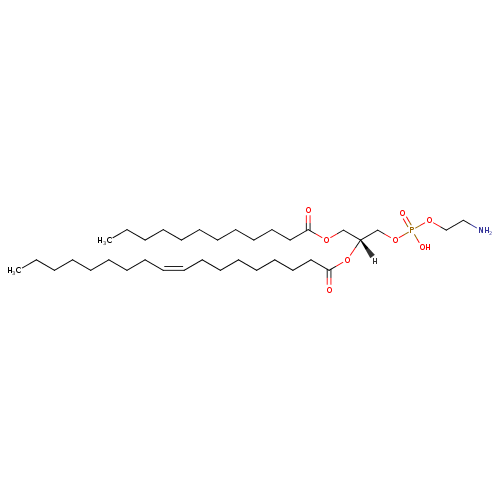
IUPAC: (2-aminoethoxy)[(2R)-3-(dodecanoyloxy)-2-[(9Z)-octadec-9-enoyloxy]propoxy]phosphinic acid
Matched Description: … phosphorylethanolamine moiety occupies a glycerol substitution site. As is the case with diacylglycerols ... fatty acid distribution at the C-1 and C-2 positions of glycerol within phospholipids is continually ... be activated by phosphorylation and then coupled to CDP. The ethanolamine is then transferred from …
Nicotinamide ribotide (ECMDB00229)
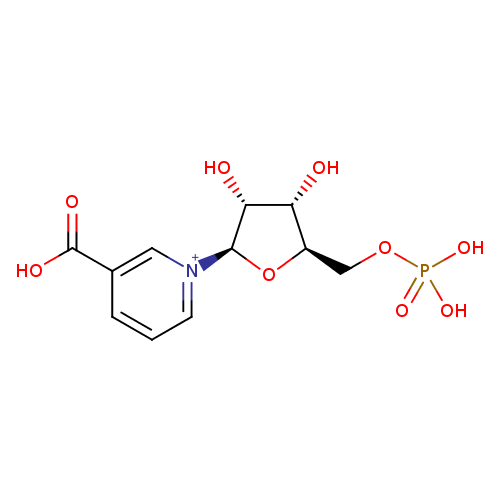
IUPAC: 3-carboxy-1-[(2R,3R,4S,5R)-3,4-dihydroxy-5-[(phosphonooxy)methyl]oxolan-2-yl]-1λ⁵-pyridin-1-ylium
CAS: 1094-61-7
Matched Description: … reactions. Thus NMN is an important metabolite for the maintenance of normal NAD biosynthesis, and ... Nicotinamide ribotide (NMN) is an important intermediate metabolite in the nicotinate and ... nicotinamide metabolism pathway. Nicotinamide is directly converted to NMN by nicotinamide …
Ubiquinol-5 (ECMDB21578)
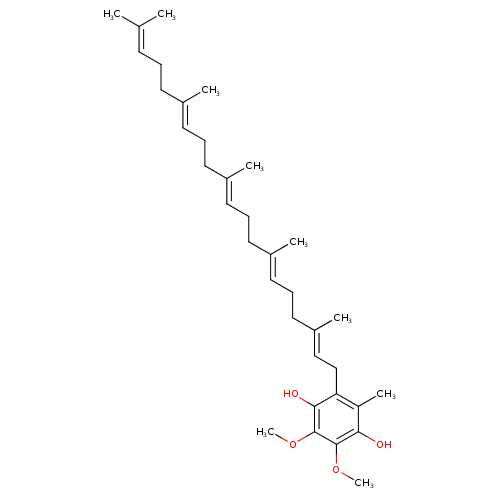
IUPAC: 2,3-dimethoxy-5-methyl-6-[(2E,6E,10E,14E)-3,7,11,15,19-pentamethylicosa-2,6,10,14,18-pentaen-1-yl]benzene-1,4-diol
Matched Description: … Ubiquinol-5 is a member of the chemical class known as Polyprenylbenzoquinols. They are reduced ... through the ETC to the oxygen, which is then reduced to water. The transfer of electrons through ETC ... , which is used by ATP synthase (located on the membrane) to generate ATP. …
Acetylphosphate (ECMDB01494)
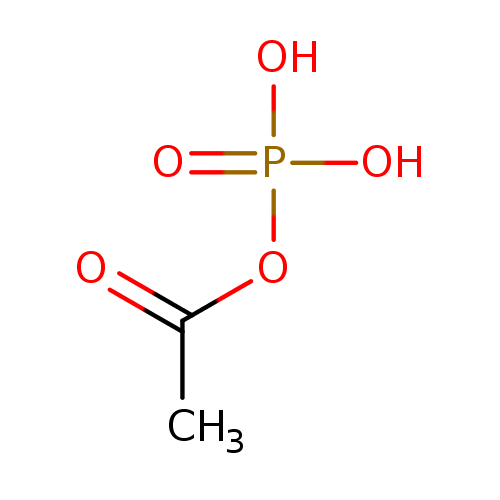
IUPAC: (acetyloxy)phosphonic acid
CAS: 590-54-5
Matched Description: … generated from pyruvate and the formation is catalyzed by pyruvate oxidase (EC:1.2.3.3). (KEGG) ... Acetylphosphate is an intermediate in taurine and hypotaurine metabolism. It is generated from ... acetate kinase (EC:2.7.2.1) respectively. It is also intermediate in pyruvate metabolism. It is …
Triphosphate (ECMDB03379)
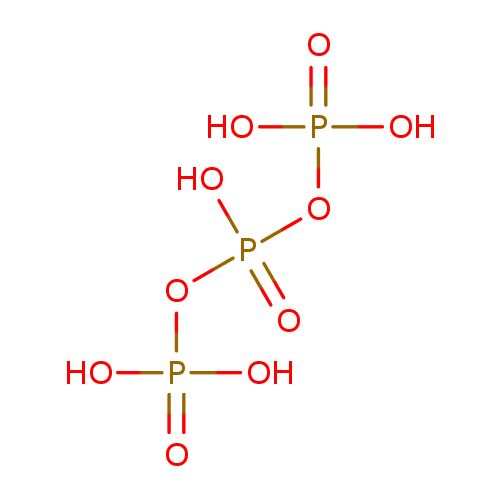
IUPAC: {[hydroxy(phosphonooxy)phosphoryl]oxy}phosphonic acid
CAS: 14127-68-5
Matched Description: … A triphosphate is a salt or ester containing three phosphate groups. It is the ionic form of ... triphosphoric acid, a condensed form of phosphoric acid. Triphosphate is an intermediate in the ... AMP) is the central route of generating energy in cells. …
Ubiquinol-2 (ECMDB21575)
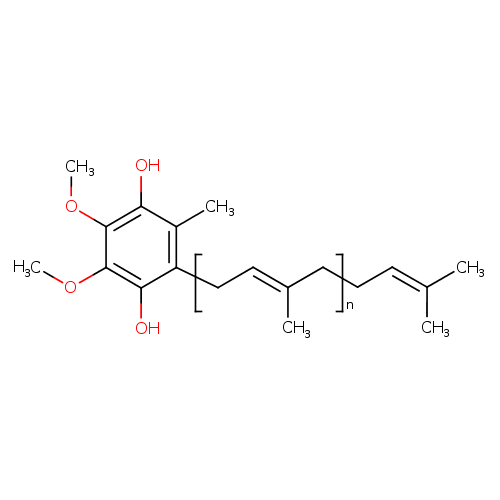
Matched Description: … Ubiquinol-2 is a member of the chemical class known as Polyprenylbenzoquinols. They are reduced ... through the ETC to the oxygen, which is then reduced to water. The transfer of electrons through ETC ... , which is used by ATP synthase (located on the membrane) to generate ATP. …
PE(16:1(9Z)/18:0) (ECMDB24115)
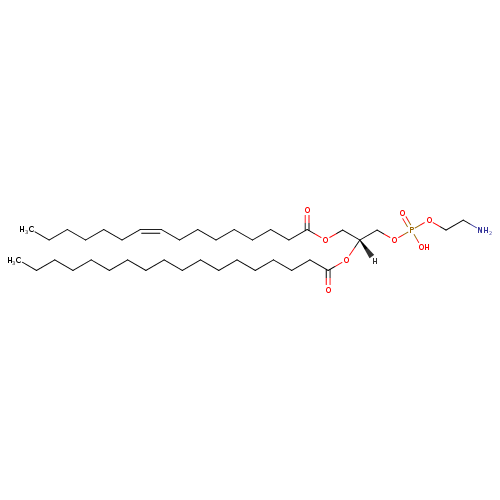
IUPAC: (2-aminoethoxy)[(2R)-3-[(9Z)-hexadec-9-enoyloxy]-2-(octadecanoyloxy)propoxy]phosphinic acid
Matched Description: … a phosphorylethanolamine moiety occupies a glycerol substitution site. As is the case with ... moiety is derived from animal fats and vegetable oils, while the stearic acid moiety is derived from ... is continually in flux, owing to phospholipid degradation and the continuous phospholipid remodeling …
Ferroxamine (ECMDB21333)
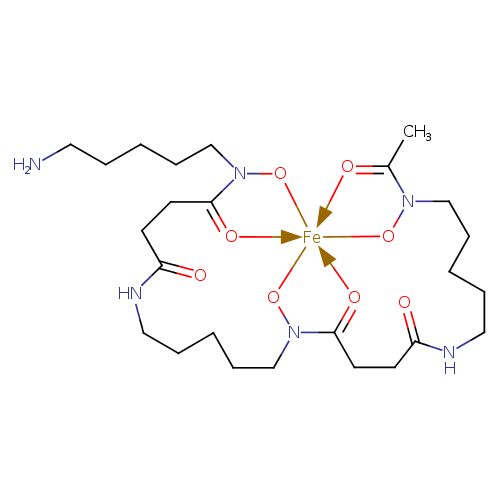
IUPAC: iron(3+) ion 3-[(5-aminopentyl)(oxido)carbamoyl]-N-[5-(N-oxido-3-{[5-(N-oxidoacetamido)pentyl]-C-hydroxycarbonimidoyl}propanamido)pentyl]propanimidic acid
CAS: 14836-73-8
Matched Description: … Ferroxamine is a member of the chemical class known as Hydroxamic Acids. These are compounds ... FhuF is involved in the reduction of ferric iron in cytoplasmic ferrioxamine B. (PMID 9990318 ... ) Insertional inactivation and gene replacement of both genes showed that while FhuD2 is involved in the …
PE(14:0/15:0) (ECMDB24103)
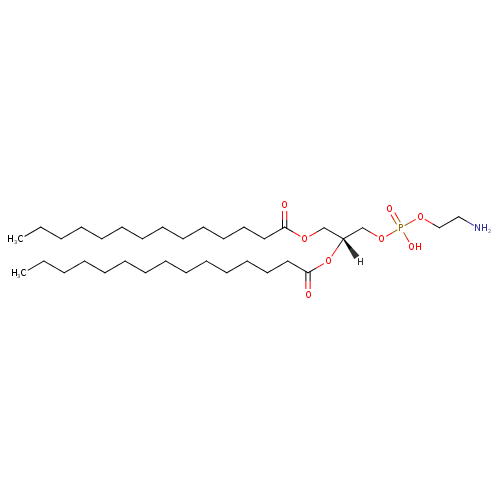
IUPAC: (2-aminoethoxy)[(2R)-2-(pentadecanoyloxy)-3-(tetradecanoyloxy)propoxy]phosphinic acid
Matched Description: … phosphorylethanolamine moiety occupies a glycerol substitution site. As is the case with diacylglycerols ... acid distribution at the C-1 and C-2 positions of glycerol within phospholipids is continually in ... activated by phosphorylation and then coupled to CDP. The ethanolamine is then transferred from CDP …
PE(16:0/14:1(9Z)) (ECMDB24110)
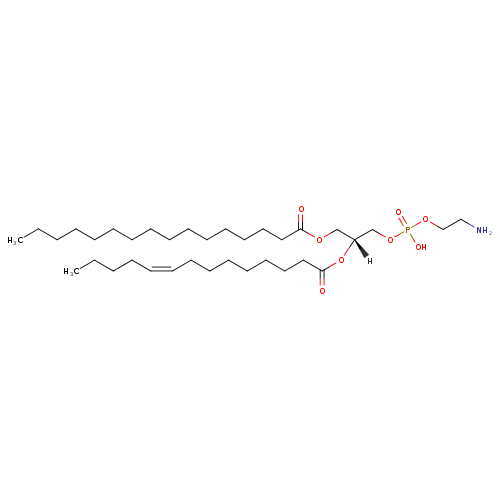
IUPAC: (2-aminoethoxy)[(2R)-3-(hexadecanoyloxy)-2-[(9Z)-tetradec-9-enoyloxy]propoxy]phosphinic acid
Matched Description: … phosphorylethanolamine moiety occupies a glycerol substitution site. As is the case with diacylglycerols ... , the fatty acid distribution at the C-1 and C-2 positions of glycerol within phospholipids is ... ethanolamine be activated by phosphorylation and then coupled to CDP. The ethanolamine is then transferred …
PE(18:0/14:0) (ECMDB24117)
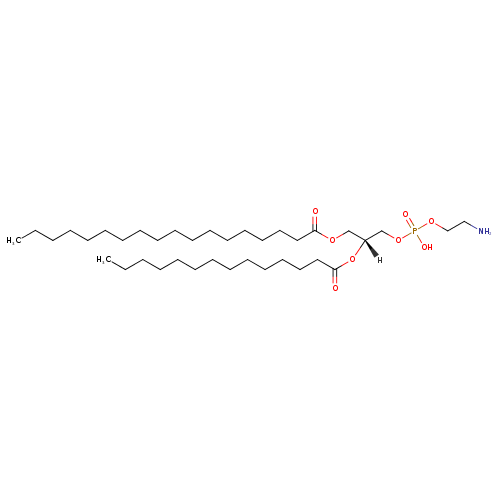
IUPAC: (2-aminoethoxy)[(2R)-3-(octadecanoyloxy)-2-(tetradecanoyloxy)propoxy]phosphinic acid
Matched Description: … phosphorylethanolamine moiety occupies a glycerol substitution site. As is the case with diacylglycerols ... acid distribution at the C-1 and C-2 positions of glycerol within phospholipids is continually in flux ... activated by phosphorylation and then coupled to CDP. The ethanolamine is then transferred from CDP …
PE(18:1(9Z)/14:0) (ECMDB24122)
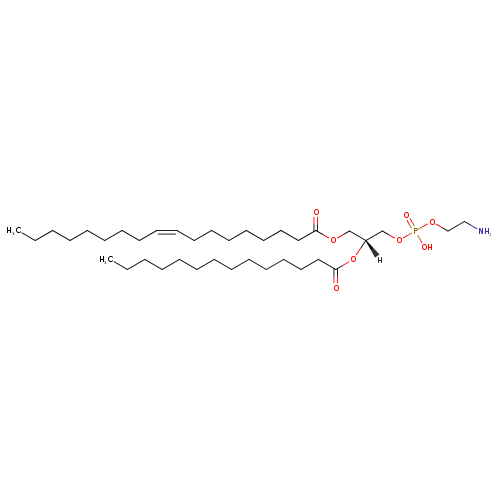
IUPAC: (2-aminoethoxy)[(2R)-3-[(9Z)-octadec-9-enoyloxy]-2-(tetradecanoyloxy)propoxy]phosphinic acid
Matched Description: … phosphorylethanolamine moiety occupies a glycerol substitution site. As is the case with diacylglycerols ... , the fatty acid distribution at the C-1 and C-2 positions of glycerol within phospholipids is ... ethanolamine be activated by phosphorylation and then coupled to CDP. The ethanolamine is then transferred …
PE(14:0/18:0) (ECMDB24324)
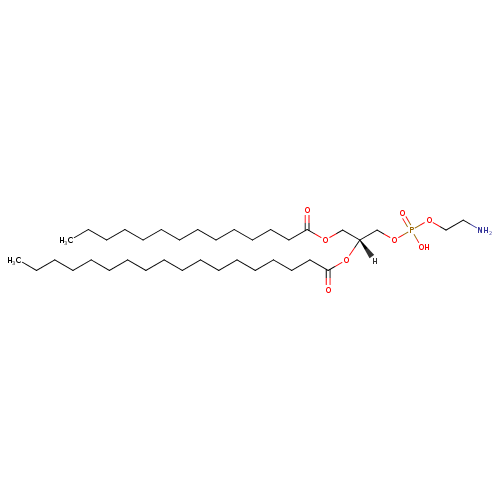
IUPAC: (2-aminoethoxy)[(2R)-2-(octadecanoyloxy)-3-(tetradecanoyloxy)propoxy]phosphinic acid
Matched Description: … phosphorylethanolamine moiety occupies a glycerol substitution site. As is the case with diacylglycerols ... acid distribution at the C-1 and C-2 positions of glycerol within phospholipids is continually in flux ... activated by phosphorylation and then coupled to CDP. The ethanolamine is then transferred from CDP …
PE(18:1(9Z)/10:0) (ECMDB24326)
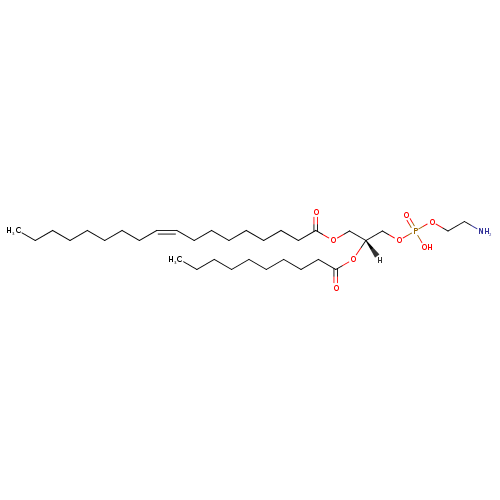
IUPAC: (2-aminoethoxy)[(2R)-2-(decanoyloxy)-3-[(9Z)-octadec-9-enoyloxy]propoxy]phosphinic acid
Matched Description: … phosphorylethanolamine moiety occupies a glycerol substitution site. As is the case with diacylglycerols ... fatty acid distribution at the C-1 and C-2 positions of glycerol within phospholipids is continually ... activated by phosphorylation and then coupled to CDP. The ethanolamine is then transferred from CDP …
PE(10:0/19:1(9Z)) (ECMDB24545)
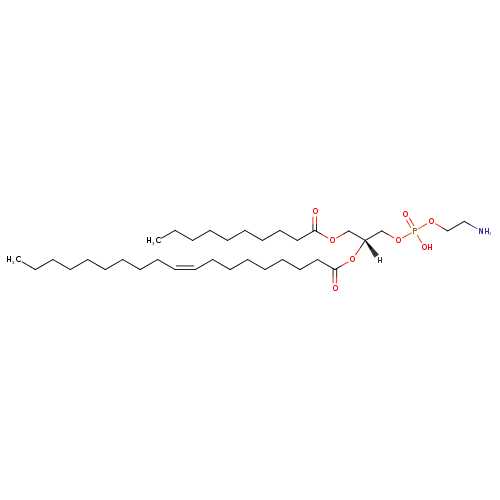
IUPAC: (2-aminoethoxy)[(2R)-3-(decanoyloxy)-2-[(9Z)-nonadec-9-enoyloxy]propoxy]phosphinic acid
Matched Description: … phosphorylethanolamine moiety occupies a glycerol substitution site. As is the case with diacylglycerols ... fatty acid distribution at the C-1 and C-2 positions of glycerol within phospholipids is continually ... activated by phosphorylation and then coupled to CDP. The ethanolamine is then transferred from CDP …
PE(19:0cycv8c/16:1(9Z)) (ECMDB24579)
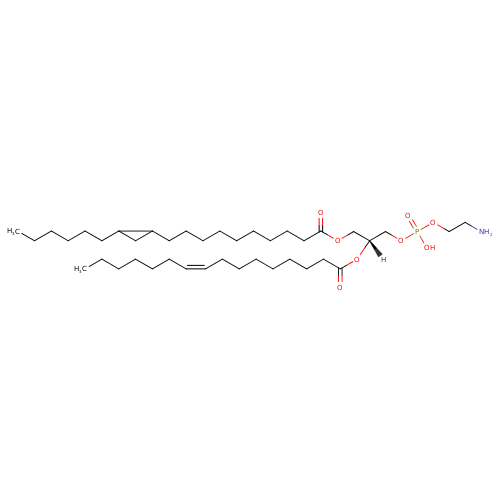
IUPAC: (2-aminoethoxy)[(2R)-2-[(9Z)-hexadec-9-enoyloxy]-3-{[10-(2-hexylcyclopropyl)decanoyl]oxy}propoxy]phosphinic acid
Matched Description: … phosphorylethanolamine moiety occupies a glycerol substitution site. As is the case with diacylglycerols ... phospholipids is continually in flux, owing to phospholipid degradation and the continuous ... ethanolamine is then transferred from CDP-ethanolamine to phosphatidic acid to yield PE. The second involves the decarboxylation of PS. …
autoinducer 2 (ECMDB24232)
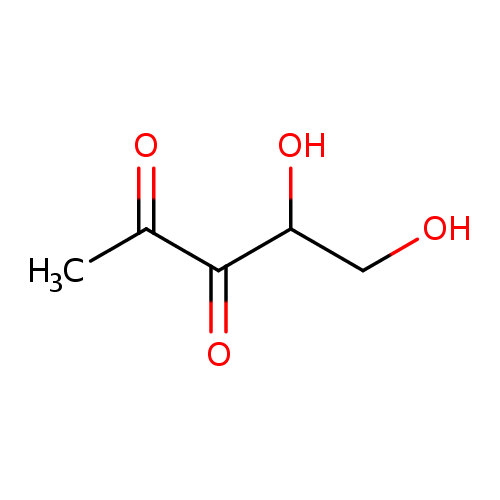
IUPAC: 4,5-dihydroxypentane-2,3-dione
Matched Description: … incorporating boron. First identified in the marine bacterium Vibrio harveyi, AI-2 is produced and recognized by ... many Gram-negative and Gram-positive bacteria. AI-2 is synthesized by the reaction of 1-deoxy-3 ... -dehydro-D-ribulose with boric acid and is recognized by the two-component sensor kinase LuxPQ in Vibrionaceae (Wikipedia). …
PE(15:0/18:1(9Z)) (ECMDB24109)
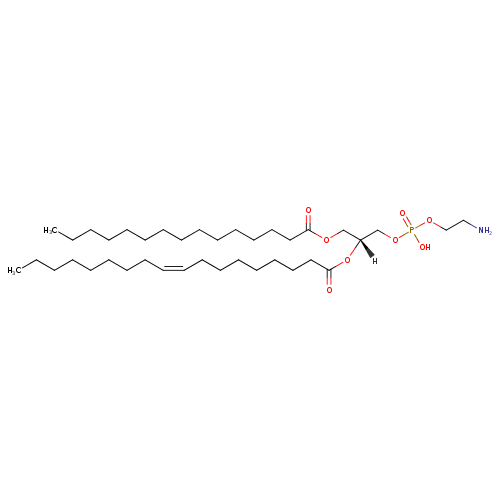
IUPAC: (2-aminoethoxy)[(2R)-2-[(9Z)-octadec-9-enoyloxy]-3-(pentadecanoyloxy)propoxy]phosphinic acid
Matched Description: … phosphorylethanolamine moiety occupies a glycerol substitution site. As is the case with diacylglycerols ... , the fatty acid distribution at the C-1 and C-2 positions of glycerol within phospholipids is ... ethanolamine be activated by phosphorylation and then coupled to CDP. The ethanolamine is then transferred …
PE(16:1(9Z)/15:0) (ECMDB24114)
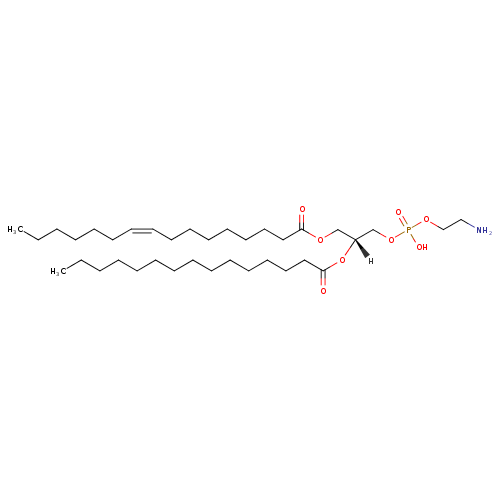
IUPAC: (2-aminoethoxy)[(2R)-3-[(9Z)-hexadec-9-enoyloxy]-2-(pentadecanoyloxy)propoxy]phosphinic acid
Matched Description: … phosphorylethanolamine moiety occupies a glycerol substitution site. As is the case with diacylglycerols ... , the fatty acid distribution at the C-1 and C-2 positions of glycerol within phospholipids is ... ethanolamine be activated by phosphorylation and then coupled to CDP. The ethanolamine is then transferred …
PE(16:1(9Z)/18:1(9Z)) (ECMDB24116)
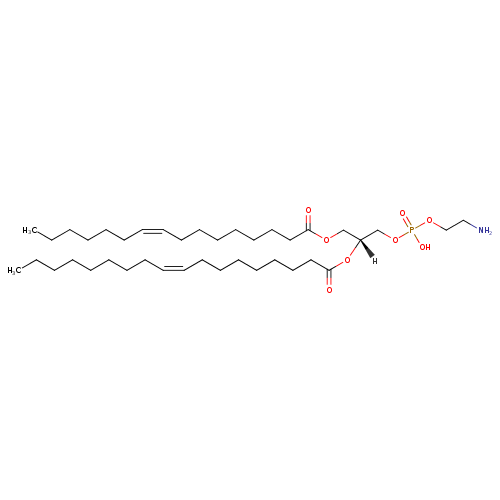
IUPAC: (2-aminoethoxy)[(2R)-3-[(9Z)-hexadec-9-enoyloxy]-2-[(9Z)-octadec-9-enoyloxy]propoxy]phosphinic acid
Matched Description: … phosphorylethanolamine moiety occupies a glycerol substitution site. As is the case with diacylglycerols ... is continually in flux, owing to phospholipid degradation and the continuous phospholipid remodeling ... ethanolamine be activated by phosphorylation and then coupled to CDP. The ethanolamine is then …
PE(18:0/18:1(9Z)) (ECMDB24121)
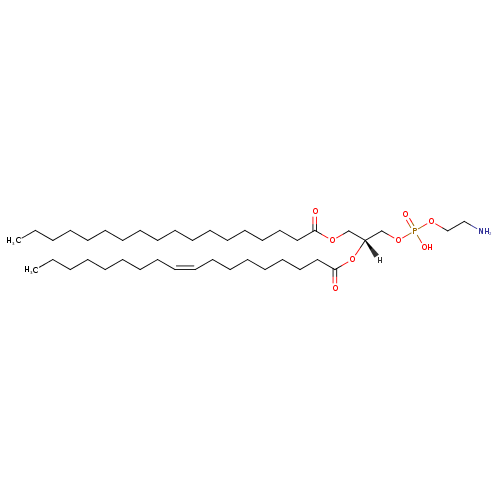
IUPAC: (2-aminoethoxy)[(2R)-2-[(9Z)-octadec-9-enoyloxy]-3-(octadecanoyloxy)propoxy]phosphinic acid
Matched Description: … phosphorylethanolamine moiety occupies a glycerol substitution site. As is the case with diacylglycerols ... , the fatty acid distribution at the C-1 and C-2 positions of glycerol within phospholipids is ... ethanolamine be activated by phosphorylation and then coupled to CDP. The ethanolamine is then transferred from …
PE(14:0/14:1(9Z)) (ECMDB24323)
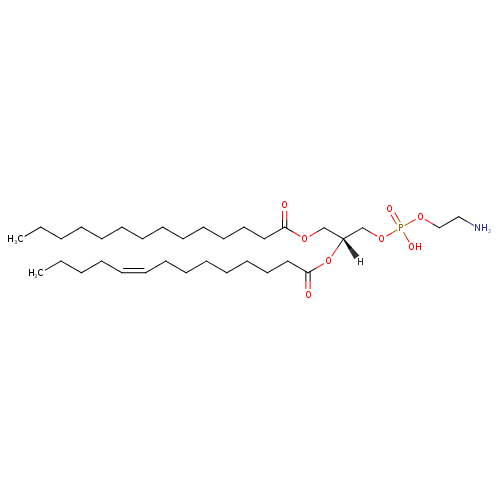
IUPAC: (2-aminoethoxy)[(2R)-2-[(9Z)-tetradec-9-enoyloxy]-3-(tetradecanoyloxy)propoxy]phosphinic acid
Matched Description: … phosphorylethanolamine moiety occupies a glycerol substitution site. As is the case with diacylglycerols ... , the fatty acid distribution at the C-1 and C-2 positions of glycerol within phospholipids is ... ethanolamine be activated by phosphorylation and then coupled to CDP. The ethanolamine is then transferred …
PE(14:0/15:0cyclo) (ECMDB24547)
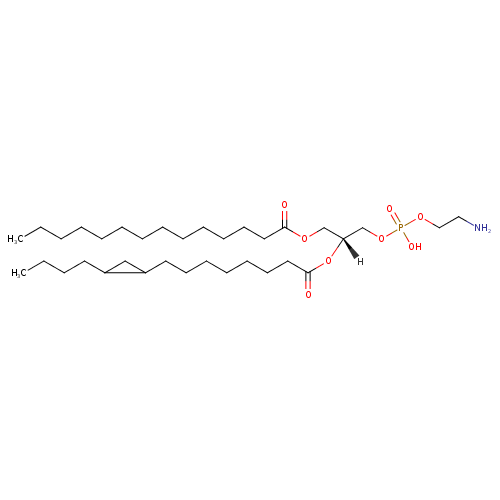
IUPAC: (2-aminoethoxy)[(2R)-2-{[8-(2-butylcyclopropyl)octanoyl]oxy}-3-(tetradecanoyloxy)propoxy]phosphinic acid
Matched Description: … phosphorylethanolamine moiety occupies a glycerol substitution site. As is the case with diacylglycerols ... phospholipids is continually in flux, owing to phospholipid degradation and the continuous ... is then transferred from CDP-ethanolamine to phosphatidic acid to yield PE. The second involves the decarboxylation of PS. …
PE(15:0cyclo/14:0) (ECMDB24552)
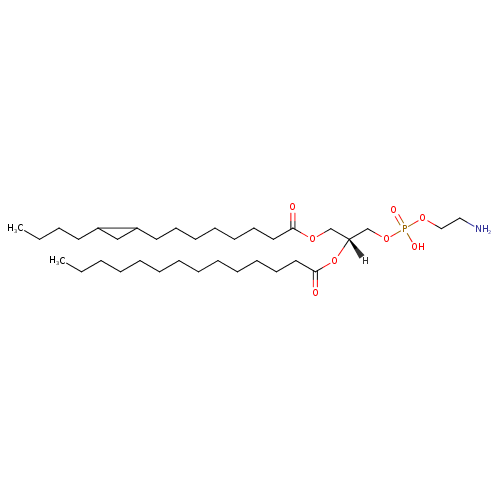
IUPAC: (2-aminoethoxy)[(2R)-3-{[8-(2-butylcyclopropyl)octanoyl]oxy}-2-(tetradecanoyloxy)propoxy]phosphinic acid
Matched Description: … phosphorylethanolamine moiety occupies a glycerol substitution site. As is the case with diacylglycerols ... phospholipids is continually in flux, owing to phospholipid degradation and the continuous ... is then transferred from CDP-ethanolamine to phosphatidic acid to yield PE. The second involves the decarboxylation of PS. …
PE(19:1(9Z)/10:0) (ECMDB24583)
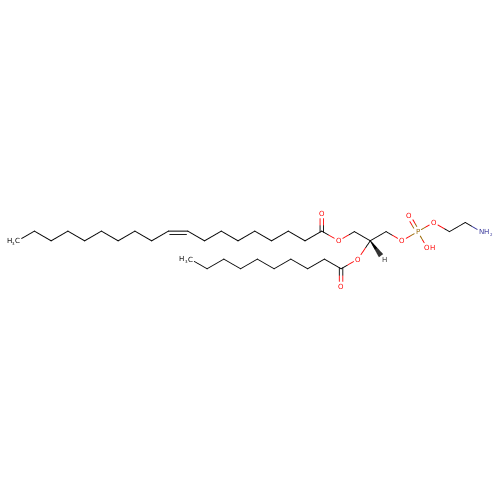
IUPAC: (2-aminoethoxy)[(2R)-2-(decanoyloxy)-3-[(9Z)-nonadec-9-enoyloxy]propoxy]phosphinic acid
Matched Description: … phosphorylethanolamine moiety occupies a glycerol substitution site. As is the case with diacylglycerols ... fatty acid distribution at the C-1 and C-2 positions of glycerol within phospholipids is continually ... activated by phosphorylation and then coupled to CDP. The ethanolamine is then transferred from CDP …