
Search Results for compound
Searching compound for Fc coins Buyfc26coins.com is EA Sports official for FC 26 coins This is the best service ever..uAXL returned 3625 results.
Displaying compounds 1401 - 1425 of 3625 in total
PE(17:0cycw7c/14:0(3-OH)) (ECMDB23511)
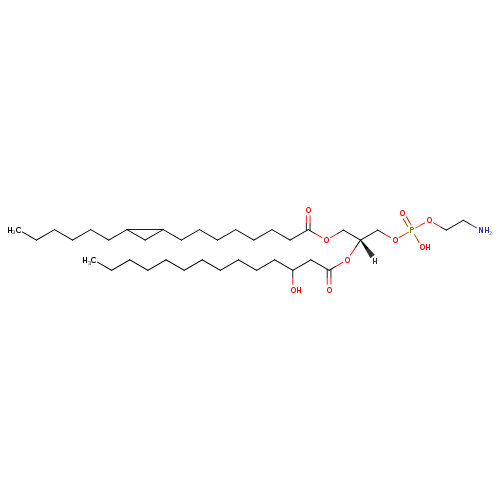
IUPAC: (2-aminoethoxy)[(2R)-3-{[8-(2-hexylcyclopropyl)octanoyl]oxy}-2-[(3-hydroxytetradecanoyl)oxy]propoxy]phosphinic acid
Matched Description: … phosphorylethanolamine moiety occupies a glycerol substitution site. As is the case with ... glycerol within phospholipids is continually in flux, owing to phospholipid degradation and the continuous ... ethanolamine is then transferred from CDP-ethanolamine to phosphatidic acid to yield PE. The second involves the decarboxylation of PS. …
PE(18:1(9Z)/10:0(3-OH)) (ECMDB23513)
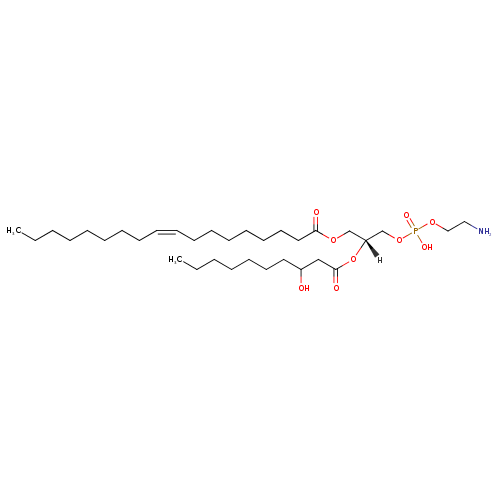
IUPAC: (2-aminoethoxy)[(2R)-2-[(3-hydroxydecanoyl)oxy]-3-[(9Z)-octadec-9-enoyloxy]propoxy]phosphinic acid
Matched Description: … phosphorylethanolamine moiety occupies a glycerol substitution site. As is the case with diacylglycerols ... phospholipids is continually in flux, owing to phospholipid degradation and the continuous phospholipid ... that ethanolamine be activated by phosphorylation and then coupled to CDP. The ethanolamine is then …
PE(19:0cycv8c/12:0(3-OH)) (ECMDB23518)
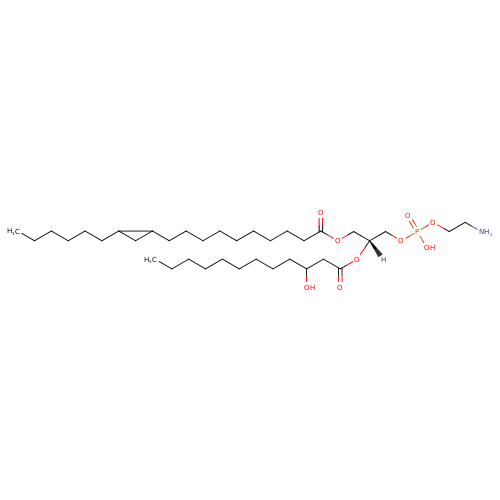
IUPAC: (2-aminoethoxy)[(2R)-3-{[10-(2-hexylcyclopropyl)decanoyl]oxy}-2-[(3-hydroxydodecanoyl)oxy]propoxy]phosphinic acid
Matched Description: … phosphorylethanolamine moiety occupies a glycerol substitution site. As is the case with ... within phospholipids is continually in flux, owing to phospholipid degradation and the continuous ... ethanolamine is then transferred from CDP-ethanolamine to phosphatidic acid to yield PE. The second involves the decarboxylation of PS. …
PE(19:iso/14:0) (ECMDB23525)
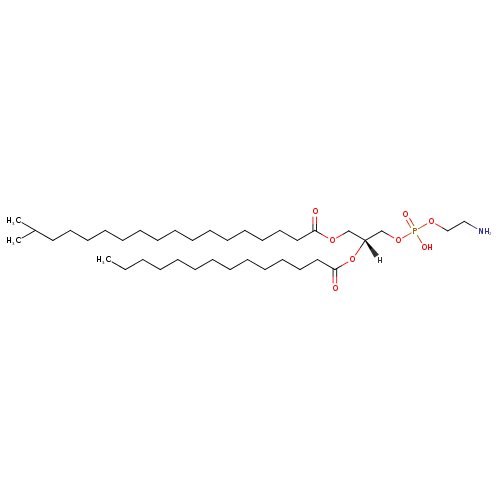
IUPAC: (2-aminoethoxy)[(2R)-3-[(17-methyloctadecanoyl)oxy]-2-(tetradecanoyloxy)propoxy]phosphinic acid
Matched Description: … phosphorylethanolamine moiety occupies a glycerol substitution site. As is the case with diacylglycerols ... , the fatty acid distribution at the C-1 and C-2 positions of glycerol within phospholipids is ... ethanolamine be activated by phosphorylation and then coupled to CDP. The ethanolamine is then transferred …
PE(19:iso/16:1(9Z)) (ECMDB23530)
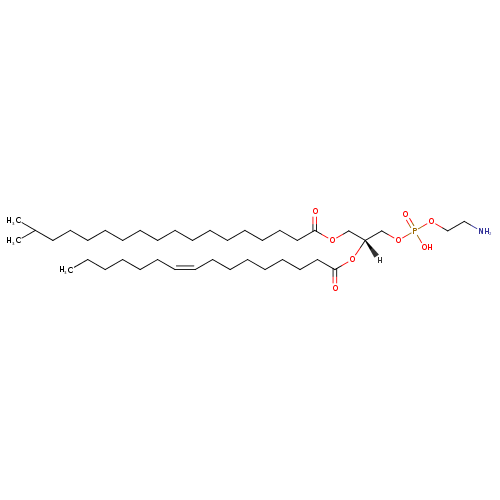
IUPAC: (2-aminoethoxy)[(2R)-2-[(9Z)-hexadec-9-enoyloxy]-3-[(17-methyloctadecanoyl)oxy]propoxy]phosphinic acid
Matched Description: … phosphorylethanolamine moiety occupies a glycerol substitution site. As is the case with diacylglycerols ... is continually in flux, owing to phospholipid degradation and the continuous phospholipid ... that ethanolamine be activated by phosphorylation and then coupled to CDP. The ethanolamine is then …
PE(14:0/19:1(9Z)) (ECMDB24550)
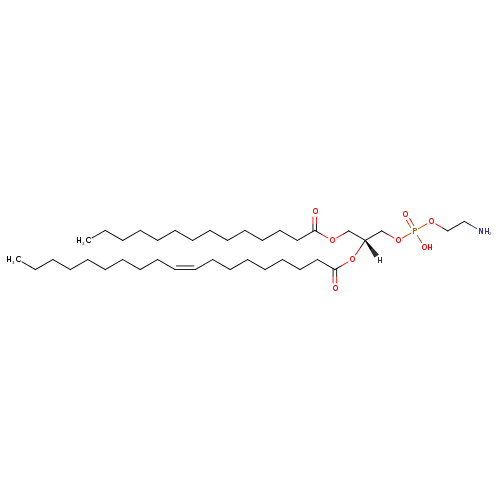
IUPAC: (2-aminoethoxy)[(2R)-2-[(9Z)-nonadec-9-enoyloxy]-3-(tetradecanoyloxy)propoxy]phosphinic acid
Matched Description: … phosphorylethanolamine moiety occupies a glycerol substitution site. As is the case with diacylglycerols ... , the fatty acid distribution at the C-1 and C-2 positions of glycerol within phospholipids is ... ethanolamine be activated by phosphorylation and then coupled to CDP. The ethanolamine is then transferred …
PE(15:0cyclo/17:0cycw7c) (ECMDB24555)
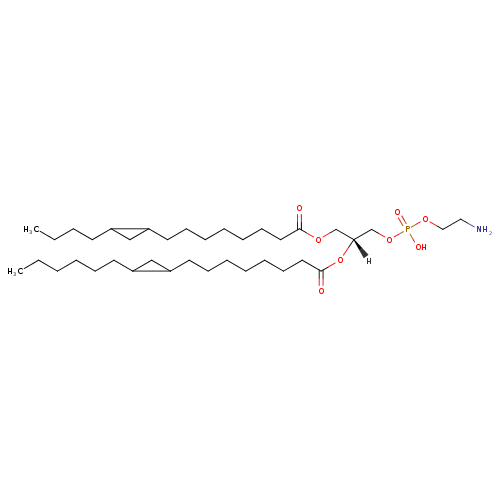
IUPAC: (2-aminoethoxy)[(2R)-3-{[8-(2-butylcyclopropyl)octanoyl]oxy}-2-{[8-(2-hexylcyclopropyl)octanoyl]oxy}propoxy]phosphinic acid
Matched Description: … phosphorylethanolamine moiety occupies a glycerol substitution site. As is the case with diacylglycerols ... to CDP. The ethanolamine is then transferred from CDP-ethanolamine to phosphatidic acid to yield PE. The second involves the decarboxylation of PS. ... PE(15:0cyclo/17:0cycw7c) is a phosphatidylethanolamine. It is a glycerophospholipid in which a …
PE(16:1(9Z)/19:0cycw8c) (ECMDB24562)
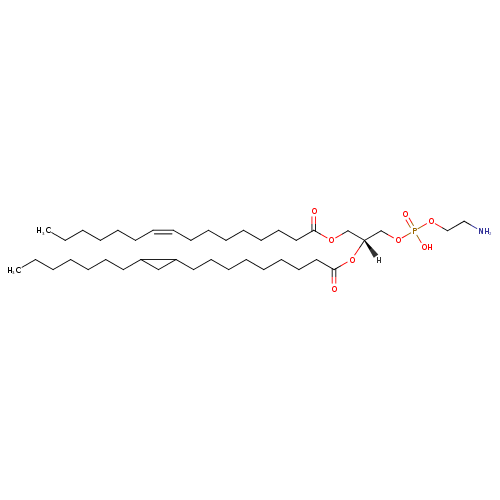
IUPAC: (2-aminoethoxy)[(2R)-2-{[9-(2-heptylcyclopropyl)nonanoyl]oxy}-3-[(9Z)-hexadec-9-enoyloxy]propoxy]phosphinic acid
Matched Description: … phosphorylethanolamine moiety occupies a glycerol substitution site. As is the case with diacylglycerols ... within phospholipids is continually in flux, owing to phospholipid degradation and the continuous ... ethanolamine is then transferred from CDP-ethanolamine to phosphatidic acid to yield PE. The second involves the decarboxylation of PS. …
PE(17:0cycw7c/19:0cycv8c) (ECMDB24569)
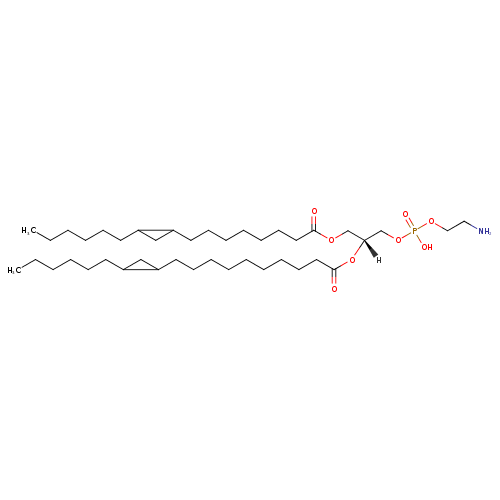
IUPAC: (2-aminoethoxy)[(2R)-2-{[10-(2-hexylcyclopropyl)decanoyl]oxy}-3-{[8-(2-hexylcyclopropyl)octanoyl]oxy}propoxy]phosphinic acid
Matched Description: … phosphorylethanolamine moiety occupies a glycerol substitution site. As is the case with ... glycerol within phospholipids is continually in flux, owing to phospholipid degradation and the ... . The ethanolamine is then transferred from CDP-ethanolamine to phosphatidic acid to yield PE. The second involves the decarboxylation of PS. …
PE(18:1(9Z)/19:0cycw8c) (ECMDB24574)
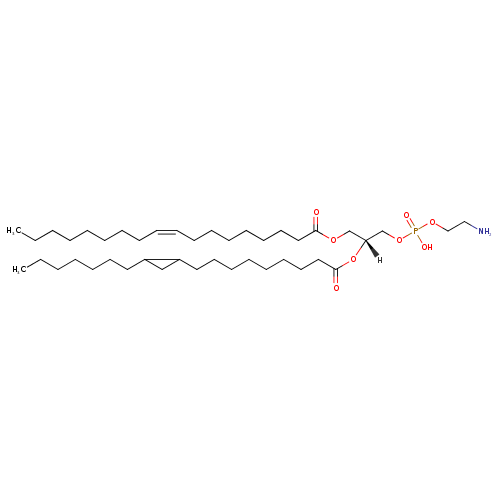
IUPAC: (2-aminoethoxy)[(2R)-2-{[9-(2-heptylcyclopropyl)nonanoyl]oxy}-3-[(9Z)-octadec-9-enoyloxy]propoxy]phosphinic acid
Matched Description: … phosphorylethanolamine moiety occupies a glycerol substitution site. As is the case with diacylglycerols ... within phospholipids is continually in flux, owing to phospholipid degradation and the continuous ... ethanolamine is then transferred from CDP-ethanolamine to phosphatidic acid to yield PE. The second involves the decarboxylation of PS. …
PE(19:0cycv8c/14:0) (ECMDB24576)
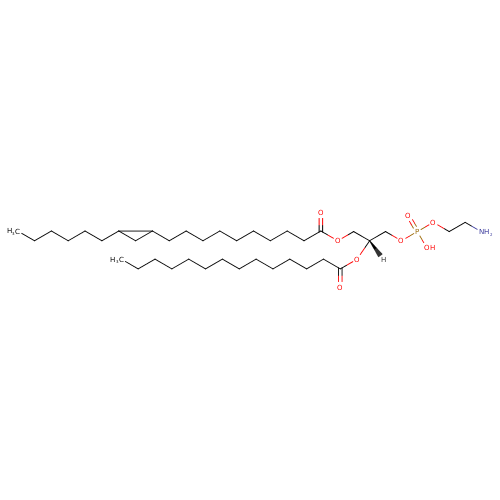
IUPAC: (2-aminoethoxy)[(2R)-3-{[10-(2-hexylcyclopropyl)decanoyl]oxy}-2-(tetradecanoyloxy)propoxy]phosphinic acid
Matched Description: … phosphorylethanolamine moiety occupies a glycerol substitution site. As is the case with diacylglycerols ... phospholipids is continually in flux, owing to phospholipid degradation and the continuous phospholipid ... that ethanolamine be activated by phosphorylation and then coupled to CDP. The ethanolamine is then …
PE(19:0cycv8c/18:1(9Z)) (ECMDB24581)
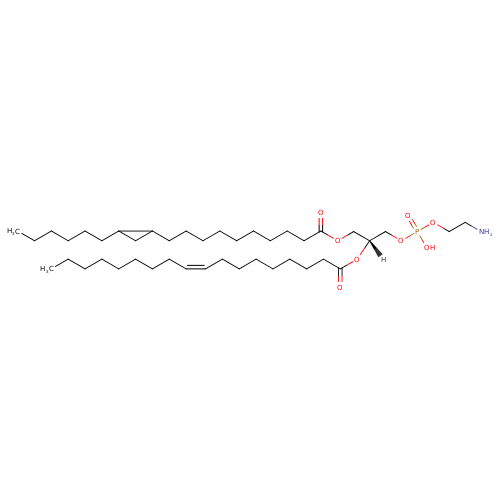
IUPAC: (2-aminoethoxy)[(2R)-3-{[10-(2-hexylcyclopropyl)decanoyl]oxy}-2-[(9Z)-octadec-9-enoyloxy]propoxy]phosphinic acid
Matched Description: … phosphorylethanolamine moiety occupies a glycerol substitution site. As is the case with diacylglycerols ... phospholipids is continually in flux, owing to phospholipid degradation and the continuous ... ethanolamine is then transferred from CDP-ethanolamine to phosphatidic acid to yield PE. The second involves the decarboxylation of PS. …
PE(19:1(9Z)/18:0) (ECMDB24588)
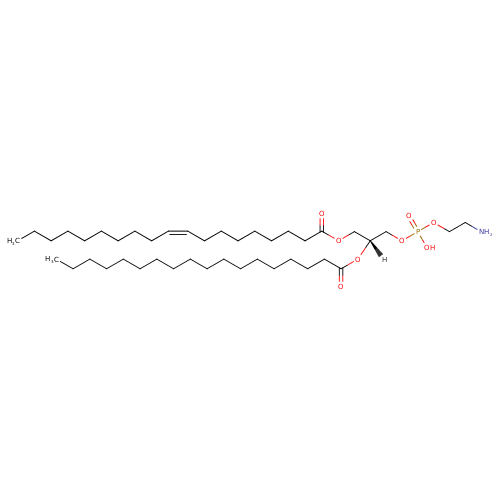
IUPAC: (2-aminoethoxy)[(2R)-3-[(9Z)-nonadec-9-enoyloxy]-2-(octadecanoyloxy)propoxy]phosphinic acid
Matched Description: … phosphorylethanolamine moiety occupies a glycerol substitution site. As is the case with diacylglycerols ... , the fatty acid distribution at the C-1 and C-2 positions of glycerol within phospholipids is ... ethanolamine be activated by phosphorylation and then coupled to CDP. The ethanolamine is then transferred from …
L-Ribulose 5-phosphate (ECMDB20167)

IUPAC: {[(2S,3S)-2,3,5-trihydroxy-4-oxopentyl]oxy}phosphonic acid
CAS: 2922-69-2
Matched Description: … L-ribulose 5-phosphate is a member of the chemical class known as Pentoses. These are ... the interconversion of ribose-5-phosphate and ribulose-5-phosphate and is a key enzyme in the ... -phosphate is an important step in the pentose phosphate pathway. (PMID 18640127) A key player in …
D-Sedoheptulose 7-phosphate (ECMDB01068)
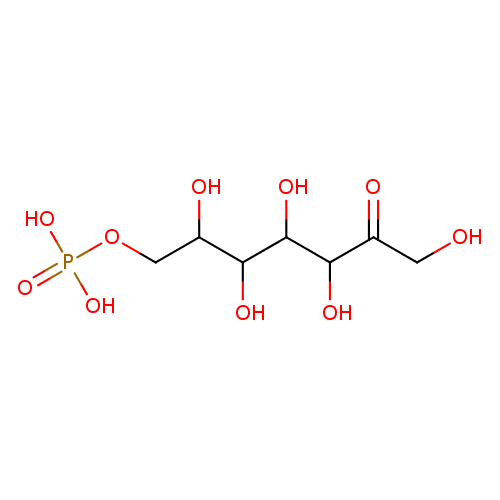
IUPAC: [(2,3,4,5,7-pentahydroxy-6-oxoheptyl)oxy]phosphonic acid
CAS: 2646-35-7
Matched Description: … D-sedoheptulose 7-phosphate is a member of the chemical class known as Heptoses. These are ... monosaccharides in which the sugar unit is an heptose. D-sedoheptulose 7-phosphate is invovled in ... . Sedoheptulose 7-phosphate is an intermediate in the pentose phosphate pathway. It is formed by transketolase and acted upon by transaldolase. …
Oxamate (ECMDB21261)
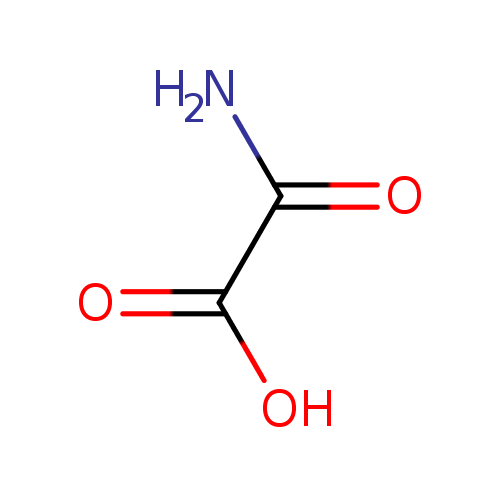
IUPAC: carbamoylformic acid
CAS: 471-47-6
Matched Description: … . The first step in allantoin degradation is the opening of the aromatic ring, yielding allantoate ... , performed by allantoinase. In the next step allantoate is hydrolyzed to S-ureidoglycine by allantoate ... Oxamate is an amino-substituted glyoxylic acid derivative. It is believed to be a product of …
beta-D-ribofuranose (ECMDB20343)
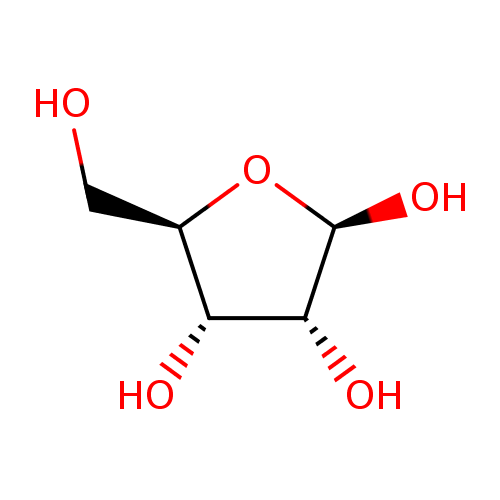
IUPAC: (2R,3R,4S,5R)-5-(hydroxymethyl)oxolane-2,3,4-triol
CAS: 50-69-1
Matched Description: … Beta-D-ribofuranose is the cyclic form of D-ribose. Ribose, primarily occurring as D-ribose, is an ... , ribose exists in the cyclic form. It comprises the backbone of RNA, a biopolymer that is the basis of ... genetic transcription. It is related to deoxyribose, as found in DNA, by the removal of one hydroxy …
GMP (ECMDB23235)
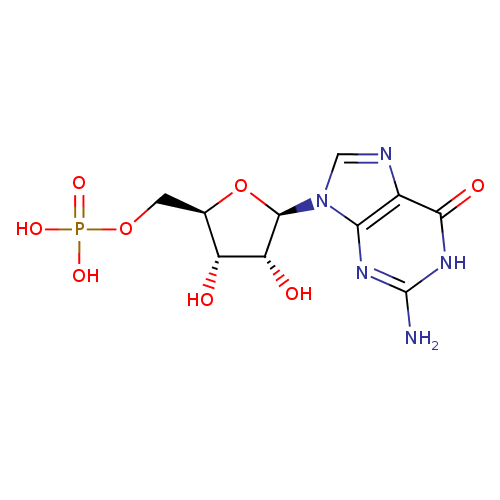
IUPAC: {[3,4-dihydroxy-5-(6-hydroxy-2-imino-3,9-dihydro-2H-purin-9-yl)oxolan-2-yl]methoxy}phosphonic acid
Matched Description: … a nucleotide that is used as a monomer in RNA. It is an ester of phosphoric acid with the nucleoside ... guanosine. GMP consists of the phosphate group, the pentose sugar ribose, and the nucleobase guanine; hence it is a ribonucleoside monophosphate. ... Guanosine monophosphate, also known as 5'-guanidylic acid or guanylic acid and abbreviated GMP, is …
Ubiquinol-7 (ECMDB21579)
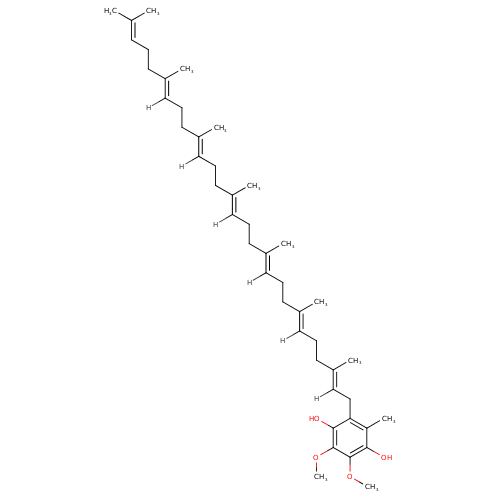
IUPAC: 2-[(2E,6E,10E,14E,18E,22E)-3,7,11,15,19,23,27-heptamethyloctacosa-2,6,10,14,18,22,26-heptaen-1-yl]-5,6-dimethoxy-3-methylbenzene-1,4-diol
Matched Description: … Ubiquinol-7 is a member of the chemical class known as Polyprenylbenzoquinols. They are reduced ... through the ETC to the oxygen, which is then reduced to water. The transfer of electrons through ETC ... , which is used by ATP synthase (located on the membrane) to generate ATP. …
DG(16:1(9Z)/19:0/0:0) (ECMDB24338)
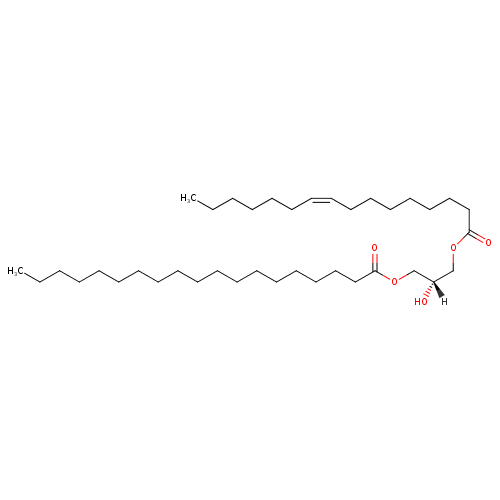
IUPAC: (2S)-1-[(9Z)-hexadec-9-enoyloxy]-3-hydroxypropan-2-yl nonadecanoate
Matched Description: … )/19:0/0:0) is also a substrate of diacylglycerol kinase. It is involved in the phospholipid metabolic pathway. ... DG(16:1(9Z)/19:0/0:0) belongs to the family of Diacylglycerols. These are glycerolipids lipids ... containing a common glycerol backbone to which at least one fatty acyl group is esterified. DG(16:1(9Z …
DG(18:1(11Z)/17:0/0:0) (ECMDB24346)
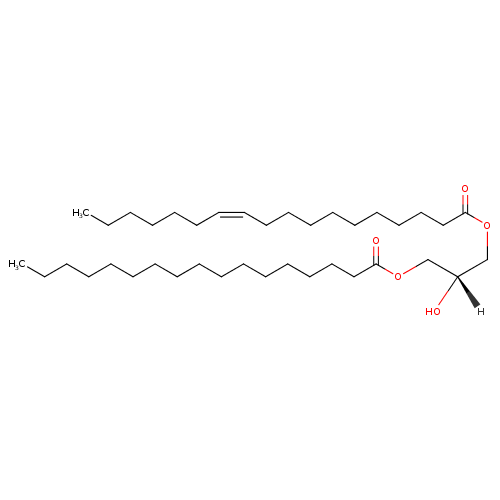
IUPAC: (2S)-2-(heptadecanoyloxy)-3-hydroxypropyl (11Z)-octadec-11-enoate
Matched Description: … )/17:0/0:0) is also a substrate of diacylglycerol kinase. It is involved in the phospholipid metabolic pathway. ... DG(18:1(11Z)/17:0/0:0) belongs to the family of Diacylglycerols. These are glycerolipids lipids ... containing a common glycerol backbone to which at least one fatty acyl group is esterified. DG(18:1(11Z …
DG(19:0/16:1(9Z)/0:0) (ECMDB24351)
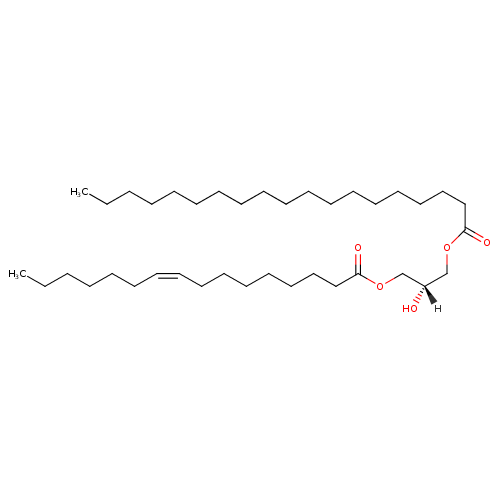
IUPAC: (2S)-2-[(9Z)-hexadec-9-enoyloxy]-3-hydroxypropyl nonadecanoate
Matched Description: … (9Z)/0:0) is also a substrate of diacylglycerol kinase. It is involved in the phospholipid metabolic pathway. ... DG(19:0/16:1(9Z)/0:0) belongs to the family of Diacylglycerols. These are glycerolipids lipids ... containing a common glycerol backbone to which at least one fatty acyl group is esterified. DG(19:0/16:1 …
DG(10:0/17:0cycw7c/0:0) (ECMDB24750)
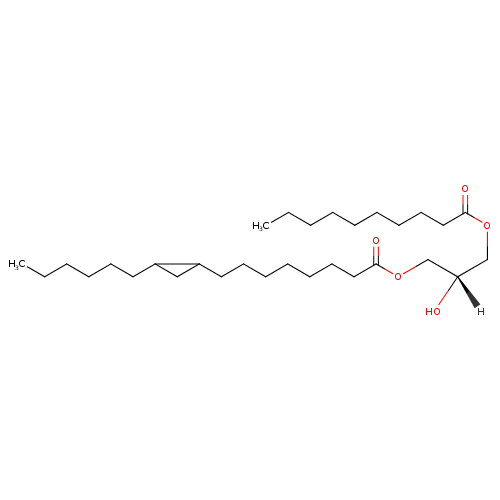
IUPAC: 2-{[8-(2-hexylcyclopropyl)octanoyl]oxy}-3-hydroxypropyl decanoate
Matched Description: … :0cycw7c/0:0) is also a substrate of diacylglycerol kinase. It is involved in the phospholipid metabolic pathway. ... DG(10:0/17:0cycw7c/0:0) belongs to the family of Diacylglycerols. These are glycerolipids lipids ... containing a common glycerol backbone to which at least one fatty acyl group is esterified. DG(10:0/17 …
DG(12:0/10:0(3-OH)/0:0) (ECMDB24762)

IUPAC: 3-hydroxy-2-[(3-hydroxydecanoyl)oxy]propyl dodecanoate
Matched Description: … :0(3-OH)/0:0) is also a substrate of diacylglycerol kinase. It is involved in the phospholipid metabolic pathway. ... DG(12:0/10:0(3-OH)/0:0) belongs to the family of Diacylglycerols. These are glycerolipids lipids ... containing a common glycerol backbone to which at least one fatty acyl group is esterified. DG(12:0/10 …
DG(14:0/12:0(3-OH)/0:0) (ECMDB24774)
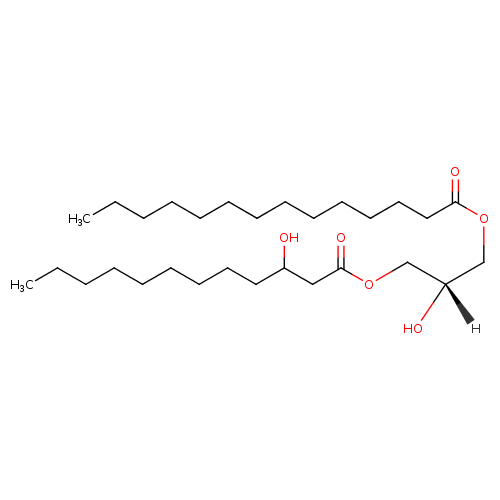
IUPAC: 3-hydroxy-2-[(3-hydroxydodecanoyl)oxy]propyl tetradecanoate
Matched Description: … :0(3-OH)/0:0) is also a substrate of diacylglycerol kinase. It is involved in the phospholipid metabolic pathway. ... DG(14:0/12:0(3-OH)/0:0) belongs to the family of Diacylglycerols. These are glycerolipids lipids ... containing a common glycerol backbone to which at least one fatty acyl group is esterified. DG(14:0/12 …